
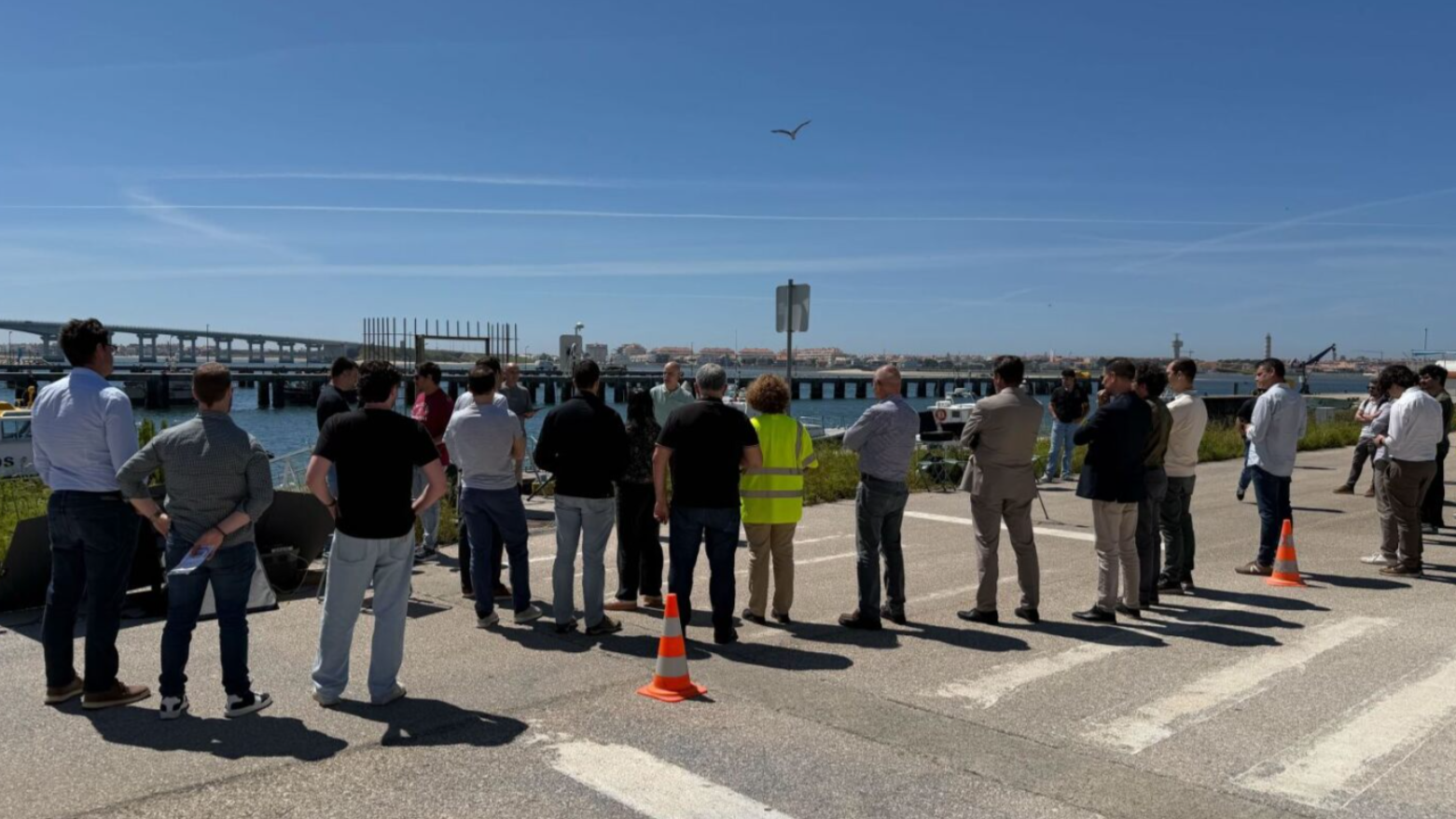
AVEIRO, PORTUGAL – On May 20, 2026, the Port of Aveiro hosted the third trial of the Portuguese cluster of the 6G-VERSUS project, bringing together partners and stakeholders to demonstrate how Beyond 5G and future 6G technologies can support safer, greener and more intelligent port operations. The session – the last one in the first trials phase – focused on the project’s Portuguese use case: improving monitoring capabilities for environmental quality, safety and infrastructure energy management in port environments.
The event opened with an overview of 6G-VERSUS – “6G VERtical trials for SUStainability” – a Horizon Europe SNS JU project exploring how advanced mobile networks, AI, edge computing and programmable network capabilities can contribute to sustainable vertical sectors. In the Portuguese cluster, coordinated by Instituto Pedro Nunes and involving IT Aveiro, Altice Labs, OneSource, JSIO and the Port of Aveiro, the work is centered on the transformation of port infrastructure into a smart, data-driven environment able to monitor, respond to and anticipate operational, environmental and energy-related needs.
Environmental awareness through connected sensing
A major focus of the third trial was Scenario 1 – Port environmental awareness and enhancement via AI and B5G/6G. This scenario addresses the need for more timely and energy-efficient environmental monitoring in the Ria de Aveiro, where the Port Authority is required to monitor water quality and report relevant findings to environmental authorities. The trial presented a custom buoy system equipped with a water-quality sensor, a solar energy harvesting module and a data logger using 5G NR RedCap communications.
The demonstrated approach combines scheduled water-quality measurements, sustainable energy supply through solar harvesting and remote data transmission to monitoring applications. The goal is to support early detection of pollution events, improve environmental coverage and reduce the maintenance burden associated with conventional sensing deployments. The trial also showcased application-level control of the buoy’s energy and communication profiles, including network QoS parameters, to improve energy efficiency.
Mobitrust platform for real-time port situational awareness
The environmental monitoring activities were also supported by the Mobitrust platform, presented as a modular situational awareness solution for real-time monitoring, supervision and operational management. The platform supports the integration of heterogeneous devices such as fixed and mobile cameras, environmental and IoT sensors, drones, unmanned aerial systems, robotic platforms and mobile devices. In the trial context, Mobitrust was used to demonstrate remote monitoring and control, live video feeds, water-quality sensor information and AI-based pollution detection.
The outdoor demonstration included a port water-monitoring setup with an autonomous monitoring boat, AI-based video analysis and devices controlled remotely via 5G. This reinforced the role of B5G/6G connectivity as an enabler for integrated situational awareness in port environments.
Safety and dynamic network management
The third trial also revisited Scenario 2 – Port safety awareness and enhancement via AI and B5G/6G, previously demonstrated in the second Portuguese cluster trial. This scenario focuses on the detection of hazardous-material transport vehicles in restricted or incorrect areas, helping port operators reduce safety risks and respond more effectively to abnormal operational events. The scenario combines AI-enabled vehicle detection, camera-based monitoring and network capabilities such as slice management and CAPIF-enabled exposure between the Network Operations N-App and the Slice Manager.
The safety scenario remains important for the Portuguese cluster because it connects operational safety with sustainability. Long queues and inefficient traffic flows at port gates can increase emissions, while dynamic network and compute resource management can help activate high-performance processing only when needed.
CAPIF-enabled network exposure for sustainable IoT
The Portuguese cluster also demonstrated how OpenCAPIF can support secure discovery and consumption of network capabilities. In the environmental monitoring scenario, the QoS N-App interacts with ONEmNEF through OpenCAPIF, enabling the selection of energy profiles for IoT devices such as the smart buoy and simplifying the use of exposed network interfaces. Additionally, in the safety-related scenario, a similar role is performed by OpenCAPIF for enabling the vertical application to interact with the Network Operations N-App.
This illustrates a key 6G-VERSUS objective: turning network capabilities into programmable tools that vertical applications can use to adapt communications according to sustainability and operational requirements.
Infrastructure energy management for smarter ports
A dedicated part of the third trial focused on Scenario 3 – Infrastructure energy management. This scenario explores how AI, 5G/6G network information and energy-aware orchestration can reduce energy waste in port infrastructure. The motivation is to reduce the energy footprint, maximize renewable energy use, support AI-based prediction and optimization, and better match energy demand with available supply. Two representative applications were presented. The first targets smart lighting, using network-based user equipment location information to adjust lamp post lighting according to presence and movement patterns. The second targets EV charger power control, using energy production information and AI-based optimization to better align vehicle charging with available renewable energy. In the wider 6G-VERSUS architecture, this aligns with the Infrastructure Energy Management AI-App, which receives energy-related information and location data, and returns recommended power configurations for systems such as EV charging and public lighting.
Toward measurable sustainability impact
The trial reinforced the project’s emphasis on measuring impact beyond traditional network KPIs. For the Portuguese cluster, relevant indicators include infrastructure energy consumption, the proportion of renewable energy used in EV charging and smart lighting, environmental monitoring coverage, pollution source identification time, and safety incident detection and response time.
By combining environmental sensing, AI-enabled safety monitoring and energy-aware infrastructure control, the third Portuguese cluster trial showed how B5G/6G technologies can support more sustainable, responsive and efficient port operations. The demonstrated work contributes to the broader 6G-VERSUS ambition of validating advanced 6G applications across real-world European trial sites, with the Portuguese cluster focused on sustainable and safe port infrastructures.